Eduqas · GCSE · English Literature
Section B (20%) Poetry 1789 to the present day
Master the WJEC Eduqas Poetry Anthology (1789–Present) with this definitive guide. Covering 18 diverse poems from Romanticism to contemporary voices, this resource unlocks the critical comparative skills and AO2 analysis you need to secure top marks.
- 5 min read
- 2 worked examples
- 4 practice questions
- 8 key terms
Study Notes
Overview
The WJEC Eduqas Poetry Anthology spans over two centuries of literary history, from the Romantic visions of William Blake and William Wordsworth to the contemporary voices of Imtiaz Dharker and Carol Ann Duffy. Worth 20% of your total GCSE, this section demands more than just knowing what the poems are about (AO1); it requires you to dissect the writers' methods (AO2) and understand the contexts that shaped them (AO3). Crucially, the exam is an exercise in comparison. You will be given one poem and must choose a second from the anthology to compare it with, exploring how both poets present a specific theme. The highest marks are awarded to candidates who can seamlessly integrate their analysis of language, structure, and form while maintaining a conceptualized, comparative argument throughout.
Listen to the companion podcast below for an examiner's perspective on how to tackle this paper:

Thematic Overview
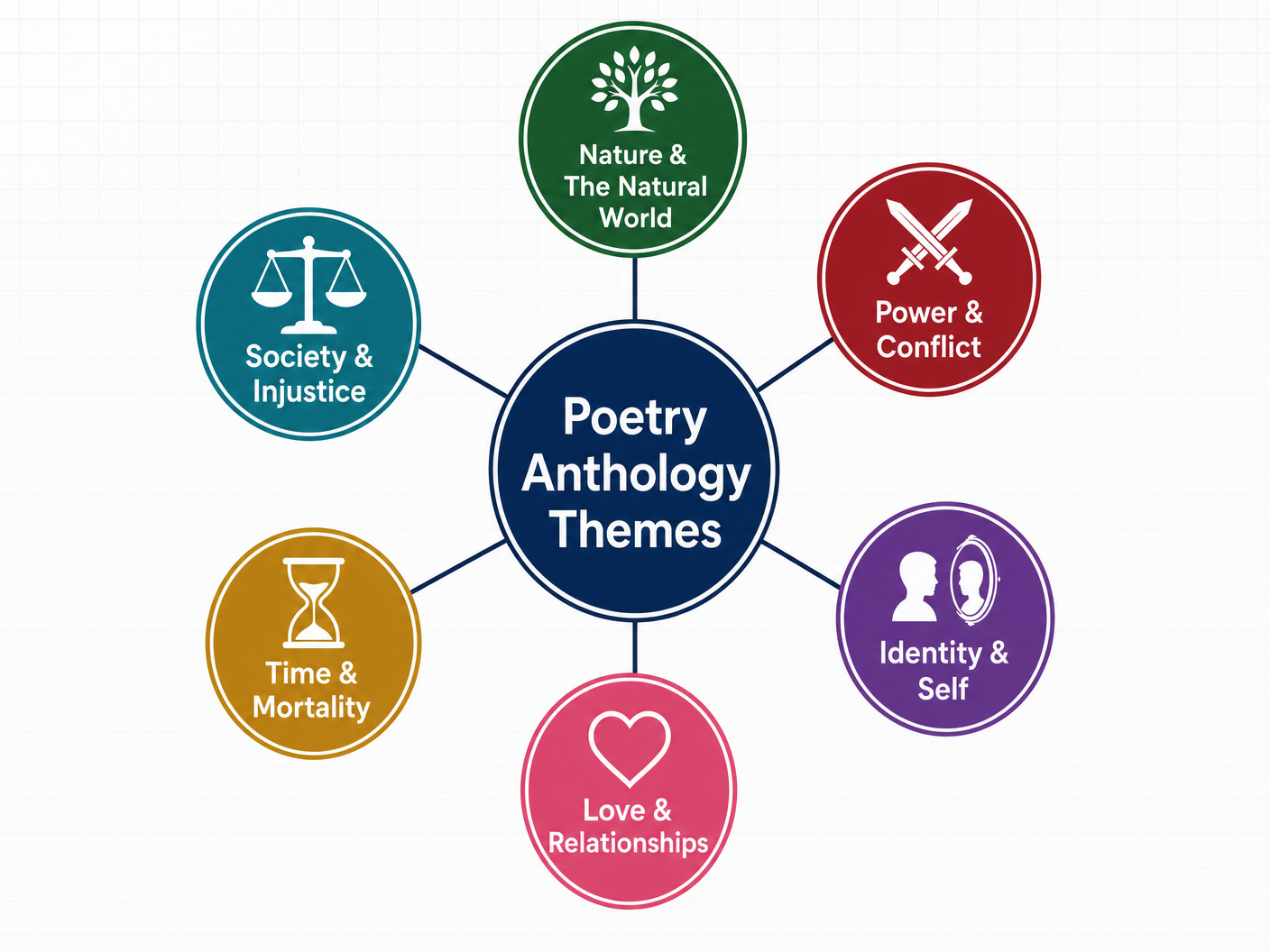
The anthology is bound together by universal human experiences. While the 18 poems cover a vast range of subjects, they broadly fall into interconnected thematic clusters:
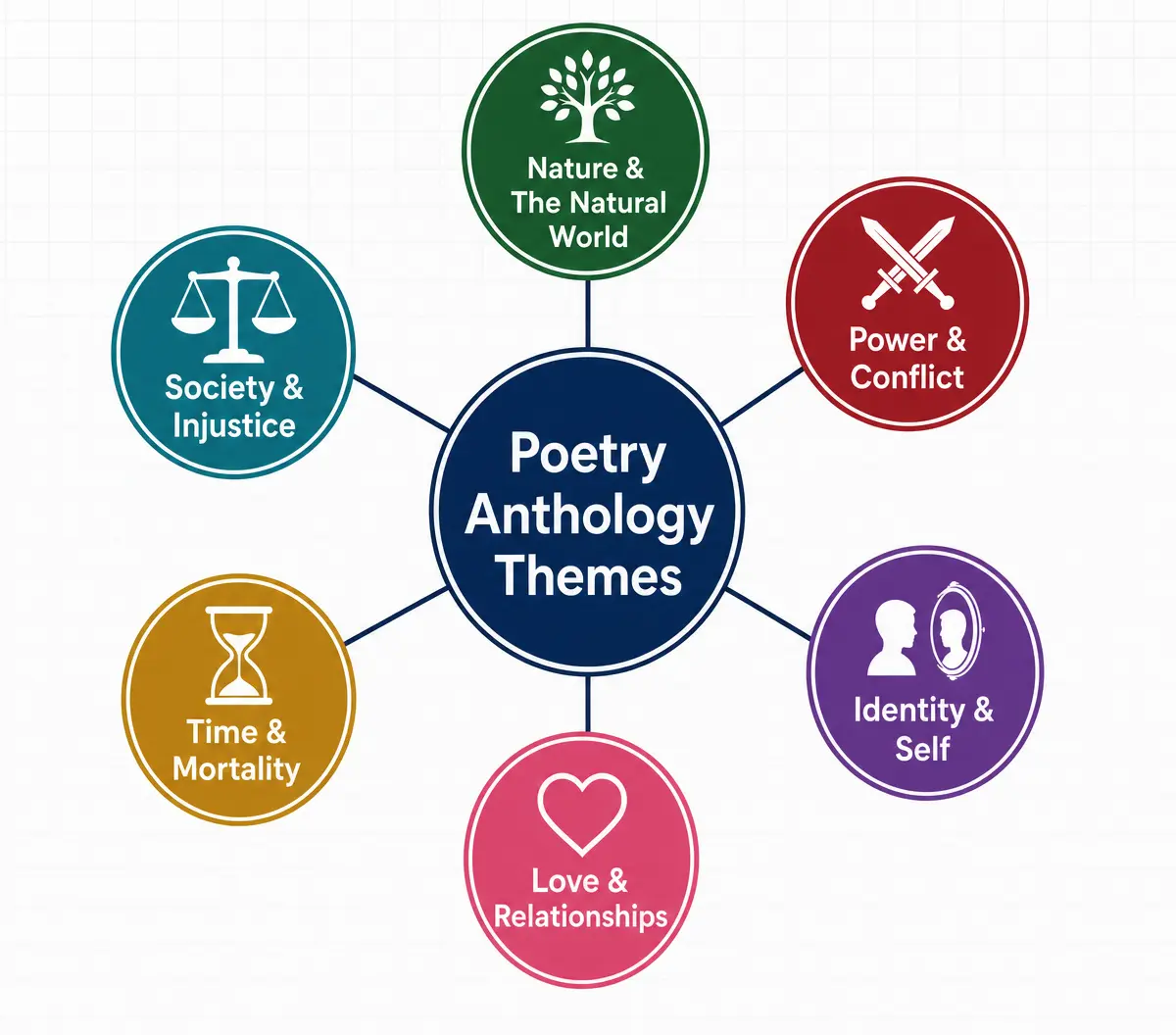
Theme 1: Nature and the Natural World
From the Romantic idealisation of nature as a spiritual force to modern anxieties about the environment, the natural world is a dominant force in the anthology.
Key Quotes:
- "Tyger Tyger, burning bright, / In the forests of the night" (The Tyger, William Blake) - Blake uses the sublime and fearsome imagery of the tiger to question the nature of creation and the creator.
- "I wandered lonely as a cloud" (The Prelude, William Wordsworth) - The simile establishes the speaker's initial isolation before finding spiritual connection and joy in the natural world.
- "Summer is fading" (Afternoons, Philip Larkin) - The passing of seasons mirrors the loss of youth and the inevitability of aging.
Theme 2: Power and Conflict
Poets frequently explore the devastating effects of war, political oppression, and the abuse of power on the individual.
Key Quotes:
- "the old Lie: Dulce et decorum est / Pro patria mori." (Dulce et Decorum Est, Wilfred Owen) - Owen bitterly subverts patriotic propaganda, exposing the brutal reality of trench warfare.
- "I sit in the top of the wood, my eyes closed." (Hawk Roosting, Ted Hughes) - The hawk serves as a metaphor for absolute, unchecked dictatorial power and arrogance.
- "Marks that of weakness, marks of woe." (London, William Blake) - Blake exposes the systemic suffering and oppression of the urban poor by powerful institutions.
Theme 3: Identity and Self
Many poems grapple with the search for identity, cultural heritage, and the feeling of being caught between worlds.
Key Quotes:
- "I have no passport, there's no way back at all" (The Émigrée, Carol Ann Duffy) - The speaker's loss of her physical homeland contrasts with the enduring, idealised memory of her city.
- "It's a huge, impossible puzzle" (Living Space, Imtiaz Dharker) - The fragile, precarious physical structure mirrors the vulnerability and resilience of those living on the margins.
Writer's Methods (AO2)
Examiners heavily reward the analysis of how poets create meaning. You must move beyond "feature spotting" to explain the effect of these methods.
- Form: Is the poem a sonnet (traditionally associated with love, but sometimes subverted, as in Ozymandias)? Is it dramatic monologue? Free verse? Form reflects the speaker's state of mind.
- Structure: Look for enjambment (which can suggest flowing thought, urgency, or lack of control) versus caesura (which creates pauses, reflection, or disruption). How does the poem shift from the first stanza to the last?
- Language: Analyze specific word choices. Don't just say "the poet uses a metaphor." Explain the connotations of the metaphorical vehicle and how it shapes the reader's understanding of the subject.
Context (AO3)
Context must be integrated, not bolted on. It is the soil in which the poem grows.
- Romanticism (late 18th/early 19th C): A reaction against the Industrial Revolution and the Enlightenment, valuing emotion, nature, and the sublime over pure reason (e.g., Blake, Wordsworth, Keats).
- Victorian Era (19th C): A period of massive social change, empire, and religious doubt, often reflected in themes of mortality and societal critique (e.g., Browning, Hardy).
- World War I (Early 20th C): The shattering of Edwardian innocence; poetry shifted from patriotic glorification to visceral realism (e.g., Owen).
- Contemporary: Diverse voices exploring modern alienation, migration, and complex identities (e.g., Duffy, Dharker, Armitage).
How to Compare
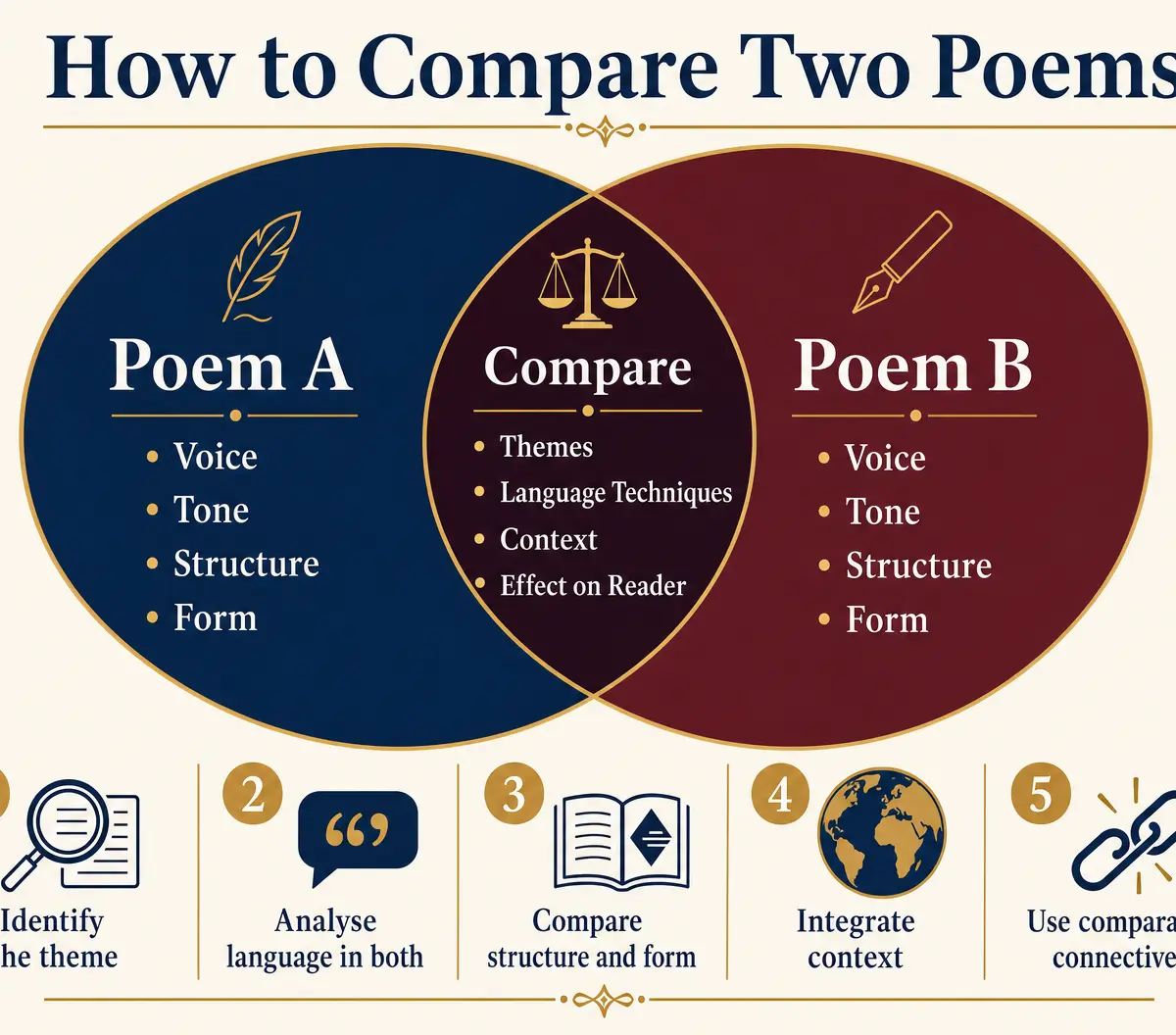
To achieve top marks, your comparison must be integrated. Use comparative connectives ("Similarly," "Conversely," "While Owen uses... Hughes employs...") in every paragraph.
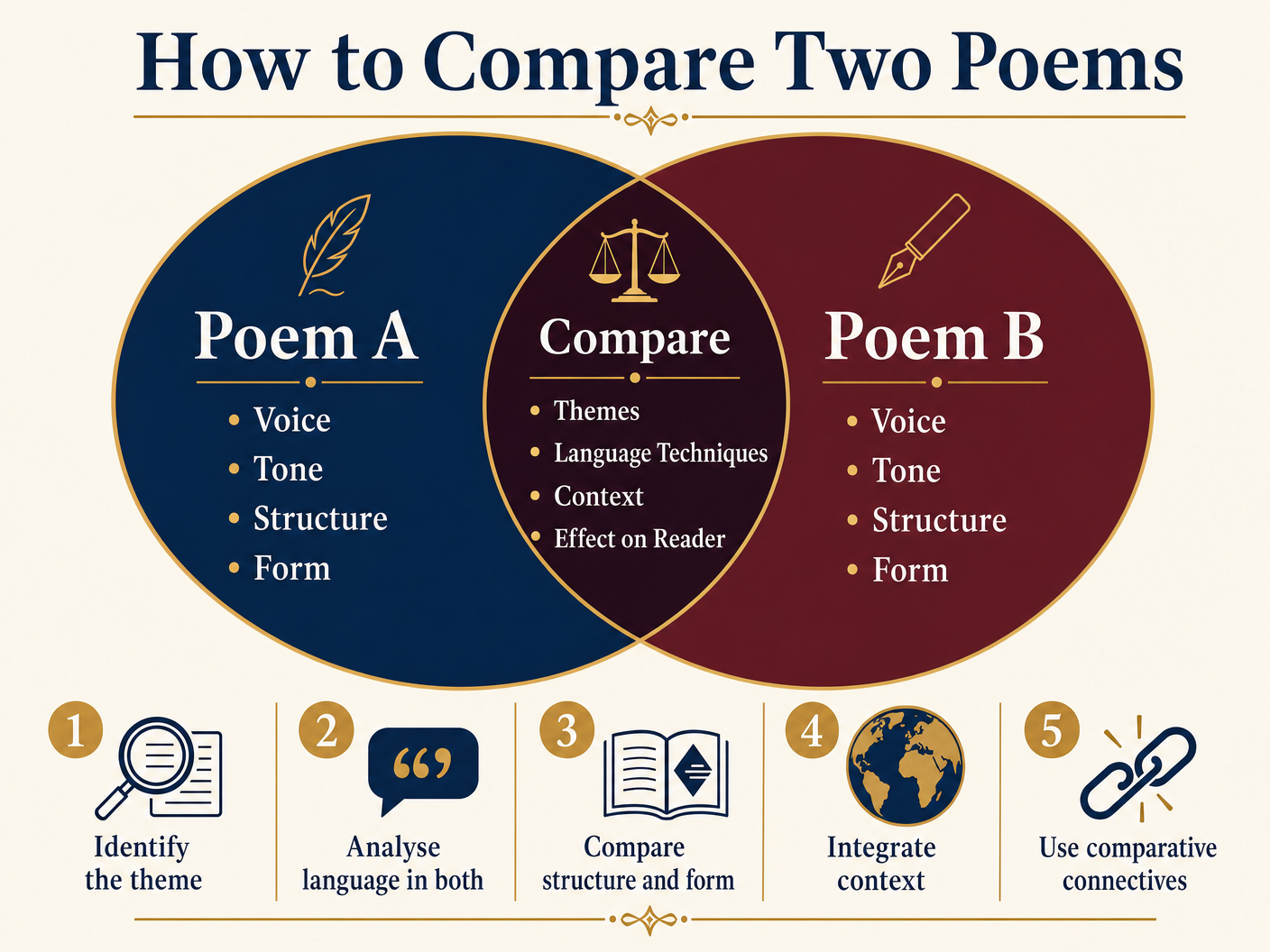
Interactive Diagrams
1 interactive diagram to visualise key concepts
Conceptual Flow Outline
The Poetry Comparison Planning Process
Worked Examples
2 worked examples — open one to explore the question and available guidance.
Practice Questions
Test your understanding — click to reveal model answers
Read the poem 'London' by William Blake. Compare how poets present the effects of society on the individual in 'London' and one other poem. (30 marks + 4 AO4)
Hint: Consider comparing with 'Living Space' by Imtiaz Dharker to contrast 18th-century oppression with modern resilience.
Read the poem 'The Prelude' by William Wordsworth. Compare how poets present the power of memory in 'The Prelude' and one other poem. (30 marks + 4 AO4)
Hint: Compare with 'The Emigree' to explore how memory acts as a source of comfort versus a source of conflict.
Read the poem 'Afternoons' by Philip Larkin. Compare how poets present the passing of time in 'Afternoons' and one other poem. (30 marks + 4 AO4)
Hint: Consider comparing with 'Ozymandias' to contrast the domestic fading of time with the epic destruction of time.
Read the poem 'Hawk Roosting' by Ted Hughes. Compare how poets present attitudes to power in 'Hawk Roosting' and one other poem. (30 marks + 4 AO4)
Hint: Compare with 'Ozymandias' to look at arrogance, or 'London' to look at the victims of power.